Copyright Licenses and You
Last Updated: Dec 11, 2025This is not legal advice. If you need legal counsel on copyright law, you should talk to a lawyer, not some random bird on the internet.
In the art communities I frequent, I've noticed there's a general misunderstanding of copyright licensure. I've written up this article in the interest of educating my peers on how they can effectively protect their work and the works of others.
What is a Copyright License?
Copyright licenses are legal documents that dictate how people can use the things you own. In this article, I'm simply going to refer to them as "licenses".
They allow for uncomplicated, clear, and concise communication of what you can and can not do with someone's work.
Different types of licenses exist for different purposes. I will focus mostly on licenses to do with software and creative works.
Asking Permission
Let's get one thing out of the way first. If the license says you can do it, then you can do it!
You do not, and should not, need to ask for permission if the license has already given it to you.
It may feel polite to ask, but in reality, you've already received your answer. The license is the exact answer to your question.
A license is a legal document, and already been specifically chosen by the person to dictate exactly what you can or can not do. By asking permission when a work is already licensed, you are effectively saying "hey, I know you already said that I can have permission to use your work, but are you extra special sure?"
To be very blunt, by asking outside the license, you're wasting both your time and that of the person whose work you want to use. At best, the person will say "check the license", and at worst, they will be annoyed about repeating themselves. You are being the opposite of polite by ignoring the answer already provided to your question.
Online, there are frequently common misunderstandings of what constitutes permissions or theft. If someone gives you grief about "not asking permission" on work covered by an open license, then they are in the wrong. Feel free to send them this article to help explain your actions.
By obeying the license, you have done everything correct, and nothing wrong. If the license does not require it, you do not need to ask for permission.
All clear? Great! Let's get into some licenses that might be useful to you.
License Examples
All Rights Reserved
"All Rights Reserved" indicates the the work is fully protected under copyright. This is considered the default copyright in most countries due to the Berne Convention and subsequent "implied copyright" agreements.
Work that has all rights reserved means that you can not use, modify, or share it without permission of the copyright holder.
For the most part, to license your work as "all rights reserved", you simply need to include this somewhere within or near the work:
Copyright 2025 [YOUR NAME]. All rights reserved.
In absence of another license, you should always assume that work is all rights reserved.
The "Fair Use" Conundrum
"But wait," you may ask. "What about fair use? Doesn't that allow for me to use copyrighted work?"
Yes, under very specific circumstances, and it changes based on country. Fair use discussion is out of scope for this article. With the advent of AI, many fair use laws are getting challenged, and rulings may soon change. Here is a great place to start reading about fair use in the USA.
Public Domain Licenses (CC0)
You're probably at least loosely familiar with the concept of the public domain. The public domain is creative work (or land) that is not protected by copyright or intellectual property rights. A work in the public domain belongs to the public — it belongs to the people. It is the polar opposite of All Rights Reserved.
For example, all US federal government creations are by default public domain. Yes, that does mean you can absolutely use all those cool NASA photos as textures in your art!
Inherently, you do not need to credit public domain work. You are not legally bound to tell anyone that you used public domain work. However, many circumstances may call for you to cite your sources, regardless of its origin.
A very common public domain license is CC0, or "No Rights Reserved". CC0 is often considered synonymous with the public domain. The official summary for CC0 is as follows:
The person who associated a work with this deed has dedicated the work to the public domain by waiving all of his or her rights to the work worldwide under copyright law, including all related and neighboring rights, to the extent allowed by law.
You can copy, modify, distribute and perform the work, even for commercial purposes, all without asking permission.
Creative Commons Licenses (CC BY, CC BY-SA, etc)
To expand on the previous point, there are several licenses created by the Creative Commons organization for creative works (visual art, music, writing, etc). These change copyright from "all rights reserved" to "some rights reserved".
Creative Commons is not used for software (coding). We will talk about software licenses later, as there are nuances to software that are not covered by the CC licenses.
There are many kind of creative commons licenses, depending on exactly what kind of permissions you want to give. You can view all of them here.
Here are some examples that may be relevant to you:
- CC BY allows for any usage of the work, commercial included, as long as attribution is given to the creator.
- CC BY-SA allows for any usage of the work, commercial included, as long as attribution is included and any iterations of the work are also licensed under CC BY-SA. (The SA stands for "share-alike".)
- CC BY-NC allows for any usage of the work, as long as attribution is given and the usage is non-commercial. You can not make money off of BY-NC work.
- CC BY-NC-ND allows for usage of the work only if attribution is given, usage is non-commercial, and the work is not derivative (the work can not be changed in any way).
There are many other CC licenses that combine all of the above permissions in any permutation you need. Browse the website and pick the one best for you! You can use their license chooser tool to help you pick one out.
In order to license your work under the Creative Commons, all you need to do is indicate this in some fashion and include a link or copy of the license itself. For example, the below is sufficient:
Copyright 2025 [YOUR NAME]. This work is licensed via CC BY 4.0.
Please keep in mind Creative Commons licenses are irrevocable. This means you can not change your mind and use a different license later... to a certain degree. You can relicense your work, but everyone who already has a copy of it will be operating under the old license. Make sure you're certain when you license your work!
Permissive Open Source Software Licenses (MIT License)
Many licenses are specifically designed for "open source" software/code. The Open Source Initiative defines "open source" as software/code that can be freely used, modified, and shared.
Software licenses frequently have clauses regarding liability. Software is a tool. A tool can be used for destructive purposes that the maker of the tool may not have intended. You may wish to allow strangers to use your code, but you don't want to be held responsible for what they do with it.
The MIT license is very commonly used for this purpose. It's very short, allows people to do whatever they want, but absolves the creator of any warranty or responsibility.
The MIT License is as follows:
Permission is hereby granted, free of charge, to any person obtaining a copy of this software and associated documentation files (the “Software”), to deal in the Software without restriction, including without limitation the rights to use, copy, modify, merge, publish, distribute, sublicense, and/or sell copies of the Software, and to permit persons to whom the Software is furnished to do so, subject to the following conditions:
The above copyright notice and this permission notice shall be included in all copies or substantial portions of the Software.
THE SOFTWARE IS PROVIDED “AS IS”, WITHOUT WARRANTY OF ANY KIND, EXPRESS OR IMPLIED, INCLUDING BUT NOT LIMITED TO THE WARRANTIES OF MERCHANTABILITY, FITNESS FOR A PARTICULAR PURPOSE AND NONINFRINGEMENT. IN NO EVENT SHALL THE AUTHORS OR COPYRIGHT HOLDERS BE LIABLE FOR ANY CLAIM, DAMAGES OR OTHER LIABILITY, WHETHER IN AN ACTION OF CONTRACT, TORT OR OTHERWISE, ARISING FROM, OUT OF OR IN CONNECTION WITH THE SOFTWARE OR THE USE OR OTHER DEALINGS IN THE SOFTWARE.
You may be familiar with the Lorekeeper project, which is a website framework for ARPG (art roleplaying game) and closed species communities. Lorekeeper and the vast majority of its extensions are under the MIT license. This means you don't need to ask permission to use it and you can do whatever you want with it, however the contributors are not responsible for your actions.
Please keep in mind that just because code is freely available on GitHub does not mean that it is open source. Someone may make their code freely available to view, but this does not always mean that you can use it.
GitHub makes it very easy for you to view the license available on a piece of software. Simply open a repository and look to the right, and you'll find your answer:
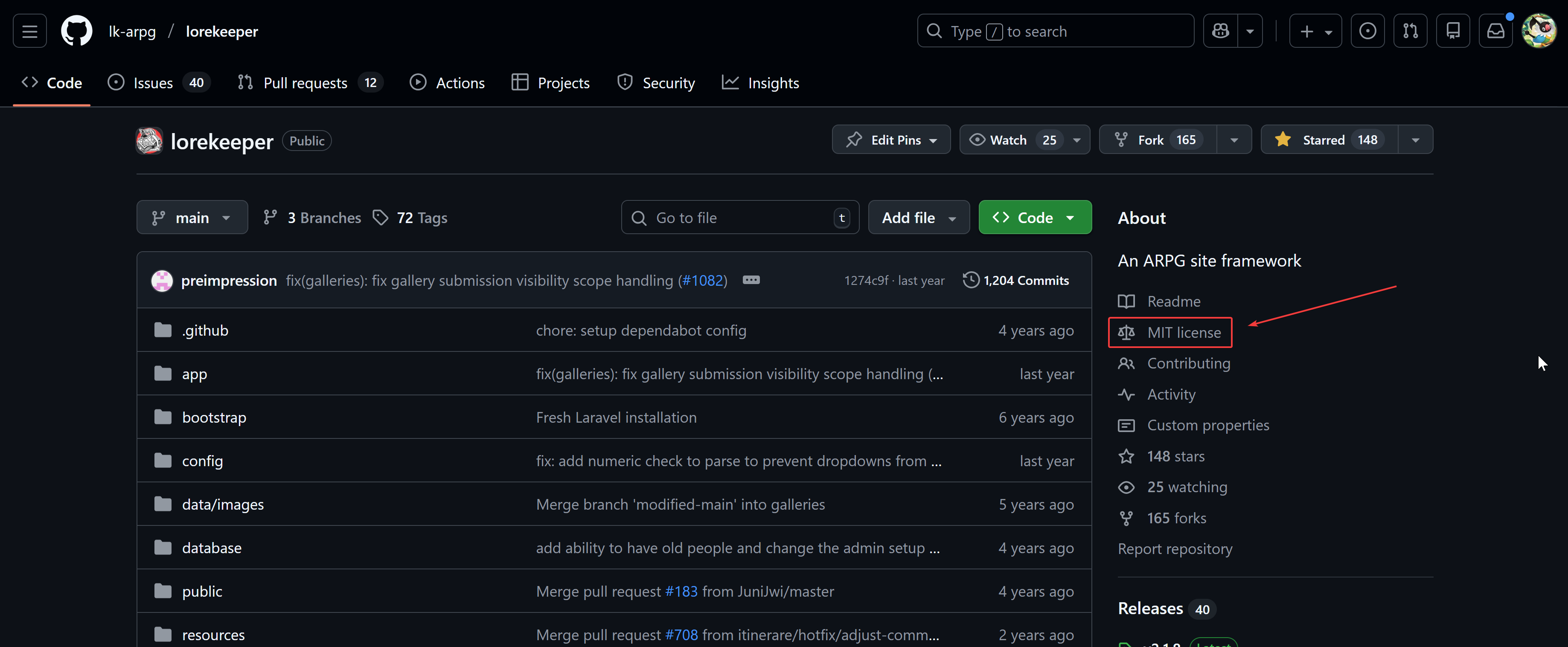
There are many, many open source licenses. You can view the ones recognized by the Open Source Initiative here.
Non-Permissive Open Source Software Licenses (GPL)
I'd like to include a note about non-permissive or copyleft software licenses. This is a special type of license used to prevent the issue of large corporations making changes to open source software, then refusing to share those improvements/updates they have made. A copyleft license is sister to the CC "share-alike" — copyleft requires any derivatives are released under the same free and open license as the original software.
You are probably most familiar with the GNU General Public License (GPL-3.0-only). This license is used for many open source art programs, such as Blender, Krita, and GIMP!
Essentially, this type of license is used to prevent corporations from taking advantage of free volunteer labor.
Conclusion
To summarize:
- Copyright licenses are legally binding documents that allow you to easily communicate how people can and can not use the things you own.
- You do not need to ask permission to use something if the license already permits it.
- There are many different kinds of licenses for many purposes.
- All rights reserved means you can not use the work without permission.
- No rights reserved, or public domain, means you can use, change, adapt, or even sell the work freely.
- Creative Commons licenses are used for creative works and not software.
- MIT (permissive) and GPL (non-permissive/copyleft) are two commonly used software licenses.
To give some real world examples of licenses:
- If I was creating a F2U base, I would license my work under CC BY. People can use the base for whatever they would like, but under CC BY, they would be required to credit me wherever it's used.
- If I was creating Toyhouse HTML/CSS codes, I would use the MIT license. This would allow people to use the code for whatever they would like and requires them to credit me. It also prevents me from being responsible for anything anyone does with my code.
I hope article has helped you a little bit in understanding the complex world of copyright! For more information, please visit the Creative Commons and Open Source Initiative websites.
Thanks for reading!